

Making volunteering more accessible
 Accelerating Volunteer Recruitment. Can it Make Volunteering More Accessible?
A topic we have heard lots about over the past year is Volunteer Passports. But what does this mean, and can it work for us in Swansea Bay? Gemma Richards, Principal Officer for Volunteering and Communications at Neath Port Talbot CVS, looks at how it could be possible.
I have supported volunteer-involving organisations and volunteers for 16 years, and have tried to break down the challenges that individuals face in accessing volunteering. Whether it be time constraints, work, or family commitments, some individuals will always have a reason for why they can’t volunteer.
I am a mother and I work full time. I know all too well how it can be a real challenge to find time to do anything in between the school runs, extra-curriculum activities, cooking, cleaning, making the packed lunches and so on.
I remember in the early days of working at Neath Port Talbot CVS, when I was inspired by individuals looking to volunteer alongside their college or university course. Individuals the same age as me (OK, possibly a bit younger!) who were also parents of small children, and were trying to balance college, work and family commitments, yet still trying to find ways in which they could volunteer. I was able to empathise with these individuals and by ‘putting myself in their shoes’, I started to really think about how we can make volunteering easier for them.
 Making volunteering accessible for families
I went on to introduce ‘Family Friendly Volunteering’ through a befriending service we delivered at the time, which enabled the volunteers to take their children along to visits. Of course, a thorough risk assessment was needed along with the usual recruitment and vetting checks to ensure everyone involved was kept safe, however it made volunteering more accessible for those who were trying to juggle family life with the many other commitments and responsibilities they had.
Introducing volunteering to children comes with many benefits. In this particular example the children got to meet new people, hear about stories from the old days, learned that some people may need a little help as they grow older, and they got to spend more time with their parents whist volunteering. It was an excellent intergenerational development and the older people that the volunteers visited were delighted to have visits from children.
 COVID-19 attracts a new group of volunteers
We have seen people of all ages and backgrounds volunteer, for various reasons and motivations. Traditionally, the group that has been the hardest to get into volunteering are those in similar situations to myself – individuals working full-time who spend any spare time running around with their little darlings! However, during the COVID-19 pandemic, this was the group of individuals who came forward to volunteer. Why was that?
Apart from the fact that we were facing a national health pandemic where people wanted to do all they could to help, things like furlough, working from home and the pause on school runs really did mean that individuals found it easier to volunteer.
Looking at trends in volunteering, we are understanding that people look for different things. Some like to commit to a volunteering role where they know exactly what they are doing and when, perhaps the same day and time each week, whereas others who aren’t able to commit would prefer one-off opportunities or roles they can do for short periods of time.
 Exploring volunteer passports in Swansea Bay
In 2021, the West Glamorgan Regional Partnership (WGRP) was awarded a Welsh Government Coronavirus Recovery Grant for Volunteering. This provided an opportunity to explore the potential viability of a Volunteer Passport Scheme across Swansea and Neath Port Talbot. Many debates took place around the pros and cons of introducing a passport scheme.
On one hand we looked at how a scheme could help prepare individuals to enter volunteering, yet on another hand we talked about the risks involved and how organisations sometimes observe volunteers during training as part of their vetting process. The idea of a volunteer passport was positive, it was just the logistics of making it work for the region that caused concerns. You can read the full report by clicking the link below:
 A chance to trial how this volunteer passports could work
In December 2021 we found ourselves in a situation where, as a nation, we were preparing for Omicron – a new COVID-19 variant which set us into emergency response mode once again! The Welsh Government needed the health boards to provide an accelerated push for boosters, which resulted in Swansea Bay University Health Board needing ‘Meet and Greet’ volunteers at their Mass Vaccination Centres (MVCs). With staff and volunteers being tired, and looking forward to their Christmas break, we knew it would be a challenge to get new volunteers recruited in the time that we had, and so the idea of an accelerated volunteer recruitment drive was explored. This gave us a real opportunity to test out what could be possible should we develop a ‘volunteer passport’ for the region.
A risk assessment was carried out and the Health Board’s Volunteer Manager contacted us to see if it would be possible to work together. An agreement that our staff and volunteers would have undertaken certain levels of checks and undertaken basic training, meant that the recruitment process could be accelerated - volunteers would not need to undertake additional vetting or training for the Meet and Greet Volunteer role.
We put a call out to staff and volunteers and collated a list of who was willing to volunteer and what shifts they could cover. This list was sent to the Health Board Volunteer Manager who made contact with each of the volunteers, providing them with a volunteer role description, a volunteer handbook and all the information they needed to undertake their volunteering.
This was a great example of how we came together and enabled the Health Board to recruit several new volunteers, get them into roles quickly and support their target in offering the booster vaccination to all eligible adults over Christmas.
 A perfect opportunity for me to volunteer
Juggling work and family responsibilities has always been a challenge for me, yet I am very passionate about volunteering and I want to help whenever I can. I often find myself looking for those one-off volunteering opportunities or short-term duties. There are so many benefits to volunteering and having ‘no time’ can often just be an excuse, or perhaps it’s the lack of knowledge in how volunteering can be done!
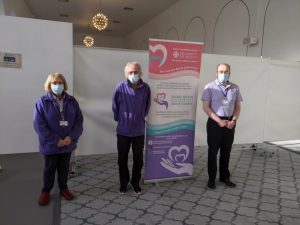
The accelerated recruitment over Christmas was the perfect opportunity for me to volunteer. I had some time off from work, plenty of family time scheduled and this opportunity to volunteer meant that I could sign up quickly without the need to undertake further training and vetting checks. I had the advantage of working alongside the Health Board and having a real understanding of the role of volunteers at MVCs. This was perfect!
For some people, going for a coronavirus vaccination in a MVC could be daunting. The role volunteers undertook in those settings enhanced every individual’s experience, making them feel welcomed and less anxious. Being able to volunteer myself made me feel part of the incredible volunteer effort that supported the Health Board in keeping Wales safe.
Those who stepped forward to volunteer provided positive feedback:
“I had the most wonderful time and had a real insight into the work”.
“It was great to get involved myself when I promote volunteering to other people in my job”.
“It was a good experience and I enjoyed it in fact. There was a great sense of comradery there too”.
“It was good to be able to help out and they really seemed to appreciate it”.
Where do we go from here?
Whilst there are reasons why volunteer passports won’t work, there are opportunities where shared training and recruitment can be beneficial for those wanting to volunteer and for those who want to recruit volunteers quickly. I still think there is work to do here around how we can make it happen, but I am hopeful we are learning lessons along the way and trialling small pilots that can be built upon in future.
I’d love to hear from any organisations across Swansea Bay who are considering developing elements of volunteer passport. Ultimately, an agreement of good practice, mutual understanding, trust and collaboration is key to making this work.
For more information about this work, you can contact Gemma Richards, Principal Officer for Volunteering and Communications at Neath Port Talbot CVS on 01639 631246 or email GemmaR@nptcvs.org.uk